Monday, November 21, 2011

Tahrir Clashes Continue Since Saturday

Egyptian riot police beat a protestor as they run through the street in downtown Tahrir
Photo credit: Khalil Hamra/AP (see the rest of the photos here)
Over the past few days there have been continuous protests in Tahrir square and in the surrounding governates such as Alexandria. The source of the violence can be traced back to a peaceful demonstration that began on Friday, not too much unlike the protests that occur every Friday after prayers in Tahrir Square, however there was more excitement surrounding this particular protest and the number of participants was much higher.

Due to the size of Friday's protest, people remained in the square until the next day when in the afternoon, riot police arrive to clear them out. Since Saturday, the violence has escalated at an alarming rate as tear gas fills the air, rubber bullets are shot and rocks are thrown from both sides. The number of people dead is hard to determine amongst the chaos.  I most recently read 24, but I have heard as high as 100, and thousands are injured.

Unfortunately for those of you reading, a poetic, on-the-scene, eye witness post is not to follow. While I spend a vast majority of my day at AUC's campus in New Cairo (45 minutes to 1 hour outside of town), even when I am at my apartment in Zamalek (10 minutes away from Tahrir) it has been eerily quiet the past few days.  The state-broadcasted news has been consistently on the big screen tv in the lobby and maybe only four or five people are sitting down watching it. Crazy how minutes away from the deadly clashes people can go about their days like nothing has changed. Is this the case in every country?

As much as the most recent violence, i.e. current violence, is unprecedented since the "revolution" in terms of protesters vs. police clashes in Tahrir, it does not reflect the opinions of all Egyptians. Speaking to my co-workers today afterwork, they were frustrated at the timing of the violence, now six days before the first round of elections, and seemed to fault the protesters equally as much as the riot police. According to them, it is important for Egyptians to see the parliamentary elections through even though they won't be perfect--that is a given when trying to reestablish a government from scratch.

Furthermore they expressed frustration at the lack of a cohesive approach of the protestors.  What do they want exactly?  Of course they want SCAF (Supreme Council of Armed Forced) to ceed to civilian rule, but isn't that what the parliamentary elections was working towards?

I am not saying anything against the protestors. They have a right and a reason (many reasons) to be frustrated and fed up with SCAF in power.  But I think it is important to highlight the spectrum of opinions in the country when the news tends to be dominated by headlining violence. I like the way my one co-worker put it, "They all seem to be singing the same song and if you're not singing it, well..." My other co-worker agreed, "If you ever write anything against the protests on Facebook you are immediately attacked.  So no one writes anything against them."

One thing for sure is these protests are the worst it has been since protests prior to Mubarak's ousting. Previously, protests and violence was predominately in Cairo, but these clashes are echoed throughout the country. It is possible this might lead to a mass evacuation of foreigners, similar to the one following the January 25th protests.

On campus, a group of students responded to the arrest of Ahmed Rahim, an AUC undergraduate, by protesting outside the Administration Building yesterday, demanding the AUC administration to intervene to help free him. At the same time just a five minute walk away on campus, four parliamentary hopefuls and AUC alumni spoke outside to a small crowd of people about how the elections will work in Egypt. This scene in itself makes me wonder whether parliamentary elections will happen in six days.  The process is complicated and new, and Egyptians have 41 political parties to choose from, literally all over the map.

Now imagine that you are the one in every four Egyptians that are illiterate.
Map by Jacopo Carbonari as posted on arabist.net.
As for me, I am glued to the news, specifically twitter. As much as twitter is a platform of self-importance to many in the United States, it is an important and impressively effective news source in Cairo. There is practically no delay between the time something happens and my ability to read it online from one of the Egyptian activists or journalists I follow. It is incredible.

I am also safe. Granted, I did have to go to the hospital on Saturday after severely cutting my pinky finger when the glass I was washing broke. After panicking for 10 minutes at the massive amount of blood, I called a friend and we decided it would be best to bandage it up ourselves and wait for the clinic to open in my building four hours later. The woman at the clinic sent me right to the hospital. Seven stitches! I tried to get away with not getting any (I was for some reason under the impression that they do not numb your finger) but the nurse insisted, "You are a lady, you can't have a big scar on your finger!"  Well, if it means I'm choosing between a scar and a husband, I guess I'll get the stitches.

More updates to come as the protests continue. 

Saturday, November 19, 2011

Why buy vegetables when you could buy camels?

Yesterday I set out on a long anticipated trip to… the camel market! The souq al gamal (camel market in Arabic) is the largest camel market in Cairo, located in the town of Birqash, a small village on the outskirts of the desert, about 35 km northwest of Cairo.  We read that the market it at its best between 8 and 10 am so we set out in a taxi bright and early.

Once at the market it was, as expected, a sea of men and well, camels. Within the first few minutes it was clear that I was the only female there.  Typical. As for the market itself, it was quite a sight as hundreds of camels were gathered in the same place. The camels that end up at the Birqash market are first brought up the Forty Days Road from western Sudan to be sold at a market in Daraw, located in upper Egypt (called upper Egypt even though it is technically southern Egypt as the Nile flows south) close to the border with Sudan.  According to one man we spoke to, it is typical for the camels to be walked the entire road aka for forty miles. Yikes! For the camels not sold in Daraw, they are trucked up to Birqash.  While I would like to think that all camels gallivant through the Sahara, occasionally holding a tourist or two, these camels are primarily bought to be eaten.

The scene was also not for the faint of heart. The camel sellers continuously beat their camels to keep them in line.  In the video below, the man in the back is auctioning off the camel in the center of the group.  I don't know how the auctioning works exactly, but I think this one went for around 7,000 pounds (approximately $1,200).  The prices seemed to range between 5,000 and 7,000 pounds.


Once the camels are sold they are dragged and hit with sticks (very much against their will) into the trucks that will transport them elsewhere.  While this process was much too unsettling for me to watch, the result is quite humorous as you casually see camel heads popping out of the backs of trucks on the roads to and from the market.

Sold camel hanging out in a truck
While the men and boys with sticks continually beat the camels to move where they want or stay in the same place, the camels still manage to run away here or there.  Unfortunately camels are not concerned with where they are running and I had to be pulled out of the way a few times to avoid being trampled.

Tyler, one of the guys I went with, was speaking to the man standing next to him during one of the auctions.  The man questioned why we were at the camel market at all since most tourists want to come to Egypt to ride a camel for a few minutes then go home. He may have been joking, (sometimes hard to tell in another language) but he also asked if Tyler was a spy.  I suppose it is odd for Egyptians to see foreigners at a market that is very normal for them, snapping away at the spectacle. But personally, I would take seeing camels bought in bulk at a market in the village over a camel ride at the Pyramids any day.  Also, what kind of bizarre spies would we be that we are checking up on the ins and outs of camel sales?


Camel waiting to be sold. Their left thighs and calves are tied together to prevent them from running away.
Quick update: As I write I am sitting by the TV downstairs in my hostel and watching the worst violence in Tahrir since the Maspero incidents. Right now I only know that protesters are injured and there was a good amount of tear gas and rubber bullets shot by the police. However, it appears as though violence is calming down.  Eerie how calm the rest of Cairo seems blocks away from the chaos.

All is well as usual on the island.

-jill

Sunday, November 13, 2011

Bring Back the Blog!

After my brief fling with group emails, I've decided I would prefer to return to my long term relationship with my blog.  Suits me better I think.  While this means I am giving up the ability to say wildly inappropriate and culturally insensitive things, I noticed that I don't say wildly inappropriate or culturally insensitive things. Well, perhaps a few of the latter but this is mostly unintentional.

For those of you who do not know, I am living in Cairo for the year as a part of the Presidential Scholars Program at the American University in Cairo (AUC).  I am the scholar in the Office of University Communications, aka web-master and king and dictator (yes, both) of the daily university bulletin, news@auc. Beware, I control the University's announcements and events, so if you get on my bad side I may change the time of that event you posted on the public calendar so no one will attend!

In reality, I am trying to revamp the program to live up to its full potential.  It is unfortunately lacking right now as the program founder and coordinator of 30 years left last January and then there was that small revolution that turned the country upside down. My first major milestone was completely revamping the website with Michelle, the scholar in the Office of the President.  Not too bad, eh? You would certainly think so if you had seen the old website (eek!). Speaking of... applications for next year's program are now open!

Since I am getting a late start to my life in Cairo, I will try to make up for lost time with extra pictures, anecdotes and a better low-down of the situation in Egypt.

Things to look forward to:

  -  Parliamentary elections in late November and December
  -  All about my trip to Siwa during Eid al Adha this past week
  -  My family is coming to Egypt for Christmas (this one should be interesting to say the least...)
  -  More pensive pictures of me looking off into the distance with the desert in the background

Most importantly, thank you for reading.

Jill

photo credit to Nancy Naser Al Deen

Sunday, May 2, 2010

Sheep's Heads and Salty Water

Sorry for the lack of posting! I have been diligently working on securing and internship and then on organizing housing and funding. This is all beside my regular load of homework and hanging out with friends - so I have been quite busy!

Here is an overview of the main things I have done over the past two weeks, one of them being an amazing trip to the Dead Sea!!

We got to go to one of the private beaches so it was less crowed and attached to a gorgeous hotel. So after eating a beyond-filling feast inside, we all ran out to the beach.


Our professor from the university (Doctor Muhammad) brought his son Salahh who was adorable. It was also cute to see Doctor Muhammad interact with him. Here the children call their Dad "Baba" and Mom "Mama" and they Dad's call their children "Baba" and the Mom's call them "Mama"! While Doctor Muhammad lived in the US for 6 years, he was still shocked to hear that we don't do the same in the US - it would be like my Mom calling me "Mom" and my Dad calling me "Dad."
The Dead Sea (as you may already know) has so much salt in it because it doesn't drain out to an ocean like other bodies of water. So the salt has been accumulating for thousands of years - so you float! You can't even sink if you tried to. Also the bottom of the sea has this dark clay material that you are supposed to spread on yourself and let dry in order to soften your skin (Hence why we have mud on ourselves).


The next week after class on Wednesday, we went to meet the "Sheikh" of the Clan "Benni Hussan" in Jordan. It is the largest and arguably the most important clan in Jordan - which is very important for a country that basis a lot of its politics on the Tribe/Clan system.

The Sheikh is a part of an ancestral line that has been leading the clan for hundreds of years. He basically mediates all problems related to the clan - no courts necessary. So if two members of a clan have a problem, they come to the Sheikh's house and talk about the problem. Then once the two men drink coffee from the cup, the problem is considered solved. If one of the parties does not want to solve the problem, they stand up and throw the coffee on the floor (very disrespectful).

Here is me with the Sheikh and his wife (may I reiterate how important he is in Jordan...)

So we spoke with the Sheikh for some time and afterwards we moved to the other room for lunch. I will classify this moment as I walked into the room for lunch as one of the most horrifying moments of my life. At first glace, it was just three platters of Mensef (the traditional Jordanian dish). Now in general I think Mensef is delicious, but this Mensef was just a little too realistic for me.

You may now be able to guess why this Mensef was not so appetizing. That's right, that is the head of a dead sheep right in the center of the platter--teeth, eyes and all.

Needless to say, I lost my appetite entirely, so I maybe ate two scoops of rice - I wasn't able to eat the sheep meat. Here is everyone eating together.


Some of the boys (like Ghawwar) were brave enough to eat the food, even traditionally with their hands. I was not so strong.But other than the food - the trip was great! Here is all the girls with the Sheikh, his wife and two daughters.

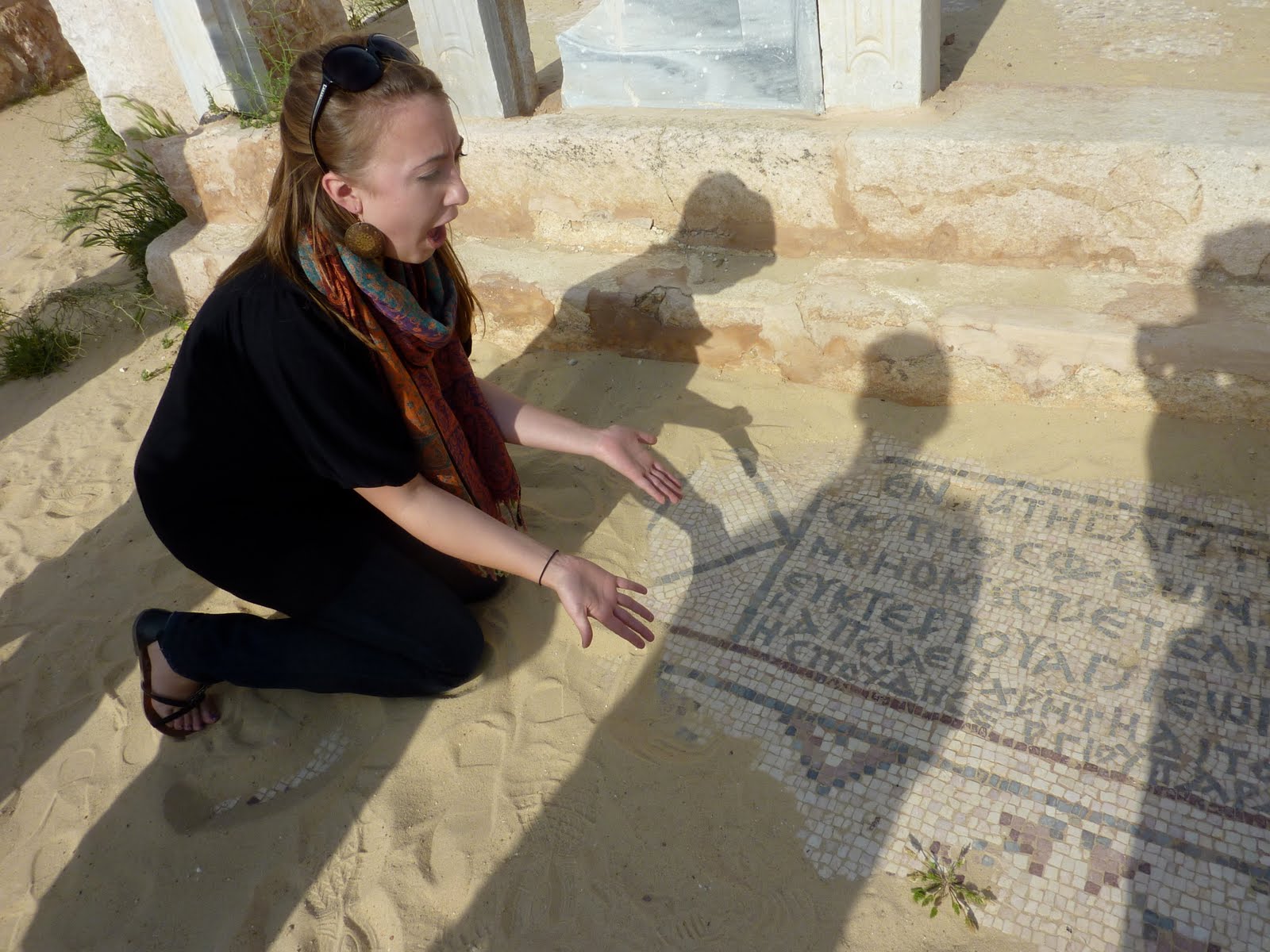
After the "meeting" we took a short trip to a part of their land in Mufruk and explored the oldest church in the world, according to what they said. There wasn't too much left of the church, but the mosaic on the ground was pretty interesting.Here I am being the first one to discover the mosaic (everything was covered with sand in order to protect it).

On Thursday we had a break from classes and took a trip together to Jerash, Abdoun, and Irbid. In Jerash there are gigantic ruins which are pretty impressive. Unfortunately, it was a popular class trip day so we were harassed by waves of loud children. Here they are... At one point I told one my name, and after that about 15 boys somehow knew it too and would rotate coming up to me and saying "Hi Yasmine!!"


Me and my new best friends:
While I don't have many pictures of the castle in Abdoun, we did have quite a bit of fun so Ill mention it anyway. We were all feeling a little sick of looking at ruins, so we played Sardines instead. And let me just say, playing sardines in a castle is AWESOME. This is me finding everyone last. Typical.
Afterwards we went to Irbid to go to one of Doctor Muhammad's friend's houses. There we saw a woman making fresh and homeade "khubez taboun" aka delicious huge bread. She made it individually in an oven in the ground set up in a shed outside their house.

Afterwards we sat down for a huge meal that they had prepared for us. It was a little odd since we barely spoke to them and didn't eat with them, I would have preferred just to talk to them. Oh well. Regardless, the food was incredible. Look!

Yacoub and Jafar smiling!
Oh! And I promised to show you a picture of Mazin, the one who we hang out with a lot and worked at the school where we teach English. Here we are below!

That's all for now! There are two weeks left of school so I am freaking out! Afterwards I have about three weeks to travel and relax but I am not positive what my plan is exactly. But I'll figure it out soon!

Saturday, April 10, 2010

A little slice of Iraq

Wow its been a while! I guess life has just been pressing along here as usual. So since there hasn't been anything that stands out exactly, I shall finally address what I have been doing every week without ever writing about it. That's right, I've been teaching English.

Oh, the shame. I promised myself I would avoid English at all costs! But this situation is a bit different. Early on in the semester Yacoub contacted one of the Arabic professors at Cornell and asked him if he knew about any volunteer work in Jordan. He put Yacoub in touch with his friend Michael who told Yacoub about a school he taught English at in Hashemi Shemali, not too far from our apartment.

In the beginning, just Yacoub and Jafar were teaching, then slowly everyone seemed to try it for a day. About 2 or 3 weeks after they started, I finally decided it wouldn't hurt just to try teaching, even though I have no experience. Turns out it was a blast. And now I've been doing it at least once a week. Sometimes up to 4 times a week!

So let me try and explain this. There is this wonderful Japanese woman, Foseio, who worked with an organization "Women's Federation for World Peace" in Japan. Then around 12 years ago she came to Jordan to start a branch of the organization and ended up staying for 12 years. Yep, she is that dedicated to the schools here, visiting her husband and children only twice a year in Japan.

The program in Jordan has at least three schools. The schools teach English as well as Arabic literacy. Most of the students in the school are Iraqi refugees, although I believe there are a few Jordanians who take primarily the Arabic literacy classes as well. These English classes, some of which I help teach, are free for the Iraqi refugees as living in Jordan is a constant struggle for them. As life wasn't hard enough as a refugee, Jordan denies all Iraqi refugees from working. Period. Up until about three years ago, children were also barred from attending Jordanian schools. For the small percentage of those who receive help from the UNHCR, their salaries are only about 75 dinars (about $100) per month (with incremental increases depending on the number of children in the family). This is barely enough to feed a family, let alone pay for electricity and water.

Needless to say, working with Iraqi refugees has become quite an interest of mine. Through taking English classes, they can increase their chances of success if they are lucky enough to gain entrance into the US, Australia, or elsewhere. The main class that I teach, sometimes on my own and sometimes with Sarah, is a group of mostly older women. They are very good at picking up the language although it is like pulling teeth to get them to come to the front of the room to practice dialogs with me. Before the first time I taught I was a little afraid to be honest. About four women in the class wear the niqab, which covers their entire body with the exception of their eyes in black. Without ever speaking to women wearing the niqab in my life, the idea was a little daunting. That fear went away after about ten minutes. They are all so wonderful! What is nice too is that they take off the part of their niqab that covers the rest of their face when Sarah and I teach the class since there are only women. Normally, or when we are not there, there is a man who teaches the class which prevents them from showing their faces at all. Plus, I can tell they like us.

I also have taught at the school in Sahab, another town a bit farther away. This school is all kids, ranging between the ages of 5 and 8, and then about 4 men. In the beginning I didn't teach there because the supervisor thought it was better if just guys from our group taught there since there were a few men in the class. Then when the other guys were traveling and they needed teachers, Jafar and I taught together and there was no problem. I have taught there a few times since and it is so much fun to teach all the kids! Plus, I use Arabic quite a bit when I talk to them (yell at them - they are noisy!) since they do not know as much English as the women in the other school. Here are some pictures!


This is Kareem being weird as usual. He is the one that is in charge of holding a stick and yelling at the kids when they get out of hand. He is hilarious.

I don't have any pictures of me teaching quite yet, but this is a picture of Khalid and Yacoub teaching.


My favorite part about this school is how much the girls who sit in the front love me. Why? Not sure. After class they just pull me down by my hand and kiss me. That was a surprise the first time that happened! Then Mazin just laughs in the background of course. Speaking of someone I have yet to mention yet... Mazin is probably 50% or more of the reason I love teaching at the school. In fact I think we (mostly Yacoub, Khalid and I) have started to split our time between teaching and just general hang-out-with-Mazin time. Mazin was the previous supervisor at the schools. He acted, and still often does, as Foseio's right hand man. They share a car, have apartments next to each other, and organize everything about the schools.

Mazin may be one of the nicest, most genuine, and open person I have met in Jordan. He often plans fun things for us to do together with him and some of his Iraqi friends. Last weekend we went to a park and barbecued and danced debka together. So much fun. The sad part is he will be leaving us soon. The good news is, he got a visa to America! We plan on putting some money together to fly him from Colorado to Cornell next semester. So now he is quickly working on his English, which he can conveniently practice with us. For anyone else I would say that is not okay since I came here to learn Arabic, but for Mazin? No problem. He speaks English to us, and we speak Arabic to him. Then from his Iraqi friends who don't speak English, we can pick up the Iraqi dialect.

One more unique opportunity I have had is visiting the houses of Iraqis in Jordan with Mazin. It is one thing to read about the situation of refugees in Jordan and quite another to go to their homes and speak to them. Probably my most valued experiences yet. The stories are terribly difficult to hear. But that is the reality of their lives. For this reason I am doing my project on Iraqi refugees in Jordan for one my classes at the university. Furthermore I am seriously thinking about making work with refugees a career choice for the near future.

I don't have any pictures of Mazin with us now, but Mazin has a bunch so once I get them from him I will post them right away!

Back to learning Arabic...